

Beyond Earth Resources


Comparison of Dark Constellations
Steven Gulberg & Alejandro Martin López
Cultures throughout the world have observed and used many phenomena of the night sky. This often included the grouping of stars into constellations or asterisms. Certain cultures also observed and identified features within the dark areas of the Milky Way where dust and gas block the light of the stars that they obscure.We discuss seven case studies of cultures across various geographical regions that feature dark constellations in their knowledge and traditions: the Maya (Mesoamerica), Inca (South American Andes), Moqoit (Argentina), Tupi (Brasil), Aboriginal and Torres Strait Islanders (Australia), Bugis (Indonesia), Xhosa, Sotho, Zulu, and Tswana (southern Africa), and Polynesians (Pacific)
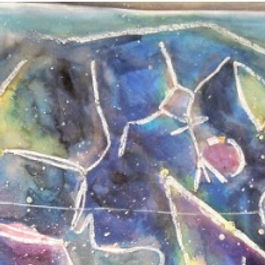
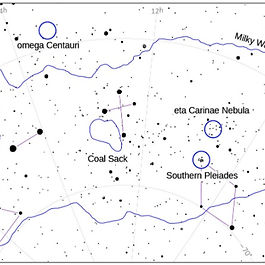
Observing the Big 5 of the African Sky
The Big 5 of the African Sky are five celestial objects that represent the best specimens of each type of deep-sky class: the Southern Pleaides (an open star cluster), omega Centauri (a globular cluster), the eta Carinae Nebula (a bright nebula), the Coal Sack (a dark nebula), and the Milky Way (a galaxy).

Demystifying the Cosmos: Beneath an African Sky
Mukandi Siame
There were no stars in the sky when the night beagan. Night of Stars was dedicated to learning about astronomy and the connection between stars, constellations, and Zambian cultural history. The African night sky are guiding lights of mythology, culture, and spirituality.
Macdonald Moyo

Star Stories: The Moose on Earth in the Sky
MOOZ is the name our ancestors used for the Moose constellation in the night sky. This visually and spiritually important autumn constellation is a reflection of the mooz/moose that lives in what is called ogidakamig: the below-world, in the northwoods of Anishinaabe Aki, the land of the Anishinaabeg Peoples.
(Oji-Cree) artist Dusty Kakegamic


THE STARRY SKY IN SÁPMI
In the Sami tradition, the starry sky in Sápmi is a cosmic hunting scene. With a life in close contact with nature and a long winter/polar night. The Sami have developed a conscious relationship with the starry sky. The Sami have lived on reindeer herding and hunting, and the Sami constellations reflect this. We find the reindeer, hunters and hunting tools among the star constellations in the sky.
Anders Fjellner


This isn’t just any ordinary star map.
Over 300 years ago, the Skidi Pawnee created a star map by hand – etched on leather – in one of the oldest surviving records of Indigenous astronomy in North America.
The Skidi (or Skiri) are one of the four main bands of the Pawnee Nation, historically located in present-day Nebraska along the Loup River. Known as expert skywatchers, the Skidi placed immense cultural and spiritual importance on the stars. Their entire worldview – including their agricultural calendar, ceremonies, and origin stories – was deeply tied to celestial patterns.
This leather star chart, now preserved at the Smithsonian’s National Museum of the American Indian, illustrates how the Skidi tracked prominent stars and constellations long before modern telescopes. To them, the night sky wasn’t just a backdrop; it was a sacred map of time, life, and creation.
The chart is a visual testimony to an ancient knowledge system – one that viewed the universe as deeply interconnected with the Earth and the people who walk it.
📸Credit: Los Altos: Ballena Press, 1982


Teaching Indigenous Star Stories
Kelly Boutsalis
As Buck and his students huddle under the dome, Buck sometimes presents the story of Sisikwun, the rattle, which mimics the sound of ice crystallizing in spring and is a sign of the approaching season—the start of a “new cycle.” Other times, he tells students that what they may know as the constellation Cepheus is also Makinak, the turtle, whose shell plates mirror the lunar cycle.
Blu Hummingbird

Aboriginal astronomy the star of Dreamtime stories
According to Aboriginal legend, emus were creator spirits that used to fly and look over the land.
To spot the emu, look south to the Southern Cross; the dark cloud between the stars is the head, while the neck, body and legs are formed from dust lanes stretching across the Milky Way.
Ray Norris
